
-small.jpg?sfvrsn=19f24713_3 "NT1_5654 - Copy (2) small")
AI isn't just the next efficiency upgrade for accounting. It's a fundamental reshaping of the profession, changing not only how accountants work, but what information they work with, how firms manage quality, and what clients will soon take for granted.
Arno Schalck, Group CIO of PIA Group, and Prof. Niels van Nieuw Amerongen of Nyenrode Business University see five major shifts.
1. From structured financial data to a much broader information base
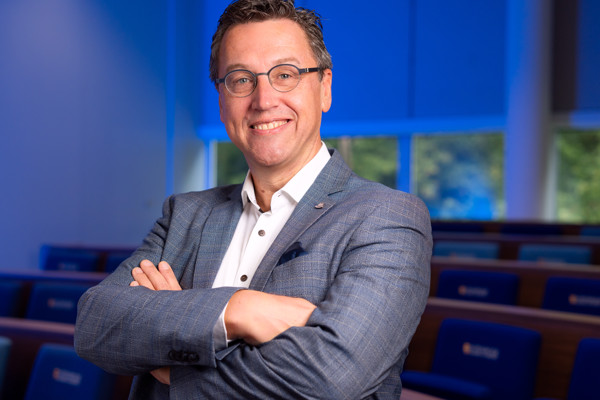
"The biggest change, of course, is that you're no longer working exclusively with structured data." — Prof. Niels van Nieuw Amerongen
Accounting used to rely mostly on structured data. AI is now bringing unstructured sources — contracts, meeting minutes, footnotes, and other rich documents — into the core of the workflow. The numbers haven't gotten less important; the information environment has simply gotten a lot richer.
Advanced data analysis tools have existed for decades. What's different now is the breadth and accessibility — rich sources are becoming part of the day-to-day process faster and more directly than ever before.
2. From doing to judging, with AI as a thought partner
Accounting has never been purely about numbers. Behind every financial outcome sits interpretation, tax considerations, risk analysis, regulations, and context, work that has always required human judgment.
AI can now increasingly support that work: processing documents, organizing insights, generating formats, and presenting information in ways professionals can use right away.
But this also means AI isn't just taking over routine tasks. It's starting to influence parts of the thinking process itself. That shifts where risks emerge and where professionals need to focus their attention. People need to understand how to handle AI output, what rules apply (legal and ethical), and where their own accountability begins.
3. Scale is a competitive advantage
Not every firm can benefit from new technology at the same pace. Scale matters a lot.
Schalck puts it plainly from his own experience: a technology investment only really pays off when it can be deployed broadly. At PIA Group, something built once can immediately apply to roughly 1,500 accountants across the Netherlands. For a smaller firm, the same investment has to be recouped across a much smaller user base.
"When we build something once, it applies to nearly 1,500 accountants and auditors. If you're a firm of fifty, that business case just doesn't hold up." — Arno Schalck
And it's not just the tools themselves. It's everything that surrounds them: compliance, methodology, quality frameworks, and specialized support.
4. Substance matters more than process
AI isn't a single application. It's a collection of different tools and capabilities. Without clear guardrails, that can lead to fragmentation, with different tools, different approaches, and ultimately different quality levels between individual professionals.
For firms, it becomes essential not just to adopt technology, but to develop a shared way of thinking about how to apply it. The real question is: how do you ensure people don't just follow the same steps, but actually reason through risk and quality from a common foundation?
Schalck sees a key difference between classical automation and AI here. In the past, you could standardize processes: same steps, same forms, same workflow. But the reasoning behind those steps stayed largely implicit. AI now makes it possible to surface and test that layer of reasoning too.
"You can tell your people: follow the same steps. But you couldn't support the substance and the reasoning behind those steps with technology. Now, with AI, we can actually add that layer." — Arno Schalck
5. Client expectations are shifting too
Technology doesn't just change the work, it changes the economics around it. Faster, better, and cheaper is becoming the new baseline.
Van Nieuw Amerongen argues that clients will eventually expect different standards for speed and quality. Schalck adds that they'll have less patience for limitations that used to be seen as just part of the job.
Where time pressure and limited visibility were once accepted realities, the expectation is growing that technology will reduce those constraints. Simply put: it's getting harder to defend not having seen something. That doesn't mean accountants need to be perfect. It means the standard is moving.
There's also pressure on the business model. If clients assume technology speeds things up, they'll naturally start asking whether fees should come down. Both speakers acknowledge this is a real tension.
Conclusion: New rules for a new profession
What this conversation makes clear is that AI isn't disrupting accounting on just one level. The change is happening simultaneously across information, methodology, organizational capacity, and market expectations — which makes it both complex and urgent.
The traditional accounting world was built around scarcity: limited time, limited visibility, limited ability to analyze all available information at the same depth. AI changes that fundamentally.
That puts the underlying choices back on the table: what do you audit, how deep do you go, what do you hand off to technology, and where does the human judgment need to stay front and center?
Schalck and Van Nieuw Amerongen agree: there's no simple blueprint for any of this. But it's clear that practice and academia need each other more than ever.
Prof. Niels van Nieuw Amerongen RA holds the PIA Group Netherlands Chair in SME Accounting at Nyenrode Business University and is a member of the Nyenrode Faculty Center of Expertise in Accounting, Auditing & Control. The chair is sponsored by PIA Group.
Arno Schalck is Group Chief Technology Officer at PIA Group. PIA Group is an accounting and advisory group serving small and mid-sized accounting firms. Their approach combines deep expertise across accounting, audit, tax, and business advisory with personalized client service. Founded in 2012 by Steven Brouckaert, PIA Group has grown into an international organization operating in the Netherlands, Belgium, and Luxembourg, with more than 75 offices and over 3,000 employees, including more than 1,450 in the Netherlands.