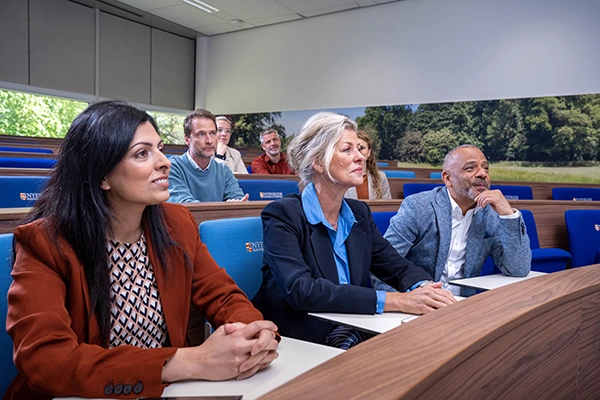
AI is increasingly able to take over tasks from people. That creates opportunities for organizations, especially now that qualified staff are expensive and scarce and many organizations are grappling with high workloads. It makes sense that organizations are embracing AI to work more efficiently and keep workloads manageable.
But what does the rise of AI mean for the role and responsibility of employees and organizations?
Prof. Dr. Lidewey van der Sluis, Professor of Strategic Talent Management at Nyenrode Business University, addresses exactly this question in her lectures. Her central message: AI is changing our work and creating additional responsibilities, but people are irreplaceable.
People are so much more than a vessel of knowledge and skills
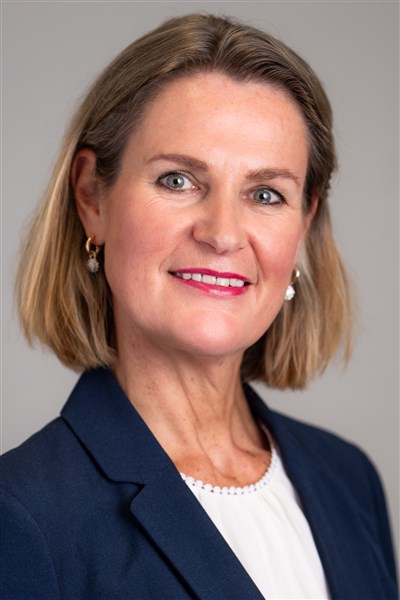
Should employees fear being replaced by AI? Van der Sluis is unequivocal.
"No, absolutely not. I actually find that an inappropriate, unethical question to ask. Because people cannot be replaced. AI will never be able to compete with our human creativity and imagination. People are so much more than a vessel of knowledge and skills. What's more, it's ultimately people who determine how AI is applied. Ideally, people remain in control of AI agents."
Although Van der Sluis believes AI can offer solutions to the tight labor market, she emphasizes the irreplaceable role of people within organizations.
"Our humanity is beyond compare. We are relational beings. In organizations, people can mean a great deal to one another. The creative power of people is remarkable. In strong organizations, that power is harnessed to help colleagues grow and thrive. There, employees are given the space to do their work and to be human. Being human means belonging and becoming who you want to be. For that, you need each other. Not AI."
Leadership arises between people
According to Van der Sluis, leadership by definition arises in the relationship between people.
"Leaders only become leaders when someone else makes them one. No one is a born leader entitled to a leadership position. That will always be true, because AI cannot turn a person into a leader. Only people can do that."
That human perspective, she says, also guides education at Nyenrode. "Our education is, and remains, human-centered, with people at its core. Organizations without people are machines. Organizations with people are living systems. People give life to organizations. And to AI."
Responsibility stays with people
However advanced AI becomes, Van der Sluis argues, responsibility for its use will always remain with people.
"In other words: within organizations, people are superior to AI and bear responsibility for their own humanity in the context of AI. AI does not. AI has no concept of responsibility. That remains with people."
Professionals must therefore keep learning and practicing what it means to be human, she says. In the age of AI, that matters more than ever.
"Nyenrode is a training ground for exactly that. We teach today's and tomorrow's leaders to be, and remain, human in the age of AI. We teach them to carry that responsibility and to build the capacity to do so, with their head, heart, and hands."
Investing in humanity and AI literacy
For Van der Sluis, being human is the foundation, but organizations must of course also invest properly in their employees' AI literacy.
"Companies need to wake their employees up where necessary, and make them more curious than ever about developments in AI. They need to ensure employees are open to new developments, not out of fear of AI, but out of interest and a desire to discover its possibilities."
This isn't just about what's technically possible. Organizations also need to consider how to deploy AI responsibly.
"How can we do things differently and better? How do we do that in a legally and ethically sound and appropriate way, with everything we can do, know, and have at our disposal? These are complex questions organizations are facing."
Executives set the direction
The rise of AI demands more from executives and directors than simply rolling out new applications, Van der Sluis stresses. They need to set the direction for how their organization engages with AI.
"Good leaders are clear about what should never be done by AI within the organization. Executives and directors will need to develop vision and policy, so that the opportunities AI offers translate into a hopeful future built on well-considered policy frameworks and inspired choices."
Organizations that manage to connect the possibilities of AI with human creativity, responsibility, and the power of human relationships are, according to Van der Sluis, best equipped for the future.
Tags
Related programs
-
AI for Boards
Start date: November 17, 2026 (Dutch, FULL) and May 10, 2027 (Dutch)Language:- Dutch
Location:- Breukelen
AI is transforming how organizations create value, operate, manage, and make decisions. The challenge you face as a board member is how to strategically navigate these changes. In this program, you will discover what AI means in practical terms for your organization and your role as an executive, non-executive or supervisory board member.
View program