

AI, sustainability, geopolitics, and new regulations: disruptions are accelerating and affecting every organization. Those that fail to adapt risk being left behind. Yet many transformation efforts fail, often because organizations react too quickly without taking the time to think strategically.
The module Disruption, Innovation & Governance, led by marketing professor Kitty Koelemeijer, teaches organizations how to become and remain agile. Harold van de Scheur, Director Format at Intergamma, the parent company of Gamma and Karwei, participated in the module. According to him, the module is highly relevant to the realities of everyday business.
Change is everywhere
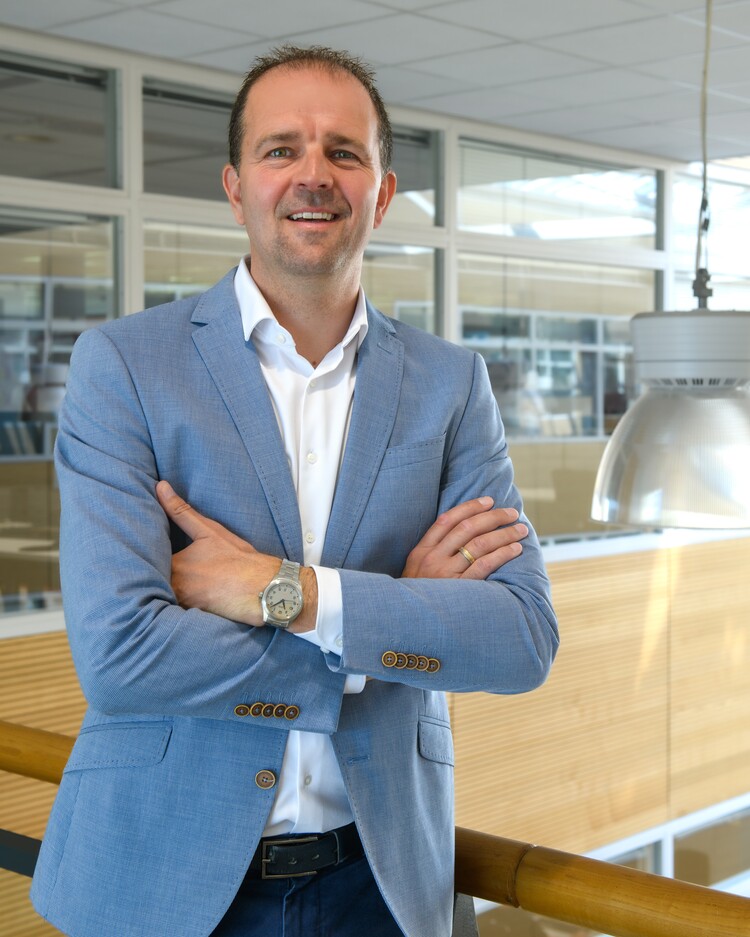 Together with his team, Van de Scheur is responsible for shaping approximately 400 home improvement stores across the Netherlands and Belgium. “We are responsible for designing and building the home improvement store,” he explains. “From the logo on the facade and the color scheme inside the store to decisions about where paint is displayed, why it is displayed there, and how much shelf space it receives.” His role has a softer side, ensuring customers feel comfortable and can easily find what they need for their projects, as well as an analytical side: maximizing the store’s performance.
From that perspective, he sees firsthand how quickly markets are moving today. “When people talk about disruption, we all know the classic examples: how Apple transformed a market or how Uber disrupted the taxi industry. But change is everywhere. We talk every day about what AI could mean for us. These are major disruptions that every company must adapt to, and developments seem to be accelerating all the time.”
Sometimes disruption is forced upon you
“You have to actively embrace change yourself.” – Harold van de Scheur
Disruption does not come only from the market. Take sustainability. “Initially, it was something driven by intrinsic motivation, a desire to do better for the environment, for people, and for the planet. Later, governments tried to enforce it through legislation. That turned out to be too strict; hardly anyone could meet the requirements. Now we are somewhere in the middle: reporting requirements provide a push, but ultimately companies need to want it themselves. You have to actively embrace change.”
That interplay is precisely what lies at the heart of the module, which Professor Koelemeijer divides into three building blocks: disruption, innovation, and governance. “She shows how organizations transform in dynamic markets,” says Van de Scheur. “How to adapt when something becomes less important and how to drive change when you want to make it important. The agile, adaptive organization is a central theme. It is highly interesting and highly relevant.”
Why transformations fail
Van de Scheur sees all around him that transformation is easier said than done. Take electrification as a means of becoming more sustainable. “Many companies want to become more sustainable by installing solar panels, adopting heat pumps, and switching to electric vehicles. But because of grid congestion, there simply is not enough electricity available. As a result, transformation efforts sometimes fail or progress more slowly. At Intergamma, we have already come a long way in making our stores more sustainable, but it certainly has not been easy.”
Why do so many organizations struggle with transformation? His answer is straightforward. “Have you taken the time to define your objective? Do you know where the opportunities and threats lie, what it takes to capitalize on opportunities or mitigate threats, and have you developed different scenarios? Those are exactly the kinds of questions you need to answer before taking action.”
AI: a powerful tool, not a magic solution
“Many companies are building AI agents, but only one in ten delivers real value. That one successful agent has to generate enough value to justify the investment in the other nine.” – Harold van de Scheur
Van de Scheur wrote his final paper on the application of AI in retail. Here too, not every innovation automatically benefits the organization. “AI is an incredibly powerful tool, but there are still many things it cannot do. A large part of my work requires creativity. You need to understand context and understand the market. AI cannot do that yet. What it can do very well is bring a prompt to life.”
AI is also expensive. “The financial newspaper FD recently reported that many companies are building AI agents, but only one in ten creates real value. That successful one then has to generate enough return to justify the development costs of the other nine.”
Organizing for speed
So how do you ensure your organization can respond effectively to change? In the governance section of the module, participants explored that question in depth. “It depends on the market you operate in. What pressures are coming from the external environment? Which developments, whether technological, geopolitical, or otherwise, affect your business model? Then you look at how your organization is structured internally. How large is the company? How formal is the organization? Where does decision-making authority reside? You learn how to organize in a way that avoids bureaucracy while preserving the speed and flexibility needed to respond to change.”
Van de Scheur would not call it immediate implementation, but the module certainly inspires action. “You spend two days at Nyenrode, away from the daily grind, discussing market disruption. On the drive home, you find yourself thinking: what does this mean for my company? What am I going to encounter tomorrow?”
Where theory meets practice
What sets the module apart for Van de Scheur is its combination of academic rigor and practical relevance. “Kitty Koelemeijer has a deep understanding of how markets, companies, and business models function. She shows how these elements come together in issues related to disruption, innovation, and governance. That makes the content highly relevant for managers dealing with change.”
Guest speakers bring those insights to life. “Kitty herself has extensive experience serving on supervisory boards and an outstanding network. On the final day of each block, she invites one or two guest speakers. We are talking about CEOs and senior executives of the highest caliber, each with a strong story related to the topic of that block. Participants can also suggest speakers. She often says, ‘I do not know whether they can or want to come, but I can always ask.’”
She also challenges participants intellectually. “You need a very strong argument if you want to defend a particular point of view. She encourages that in a very engaging way.”
For leaders dealing with transformation
According to Van de Scheur, the module is not aimed at one specific type of professional. “Look at the topics we have discussed: sustainability, AI, electrification, technological innovation, changes to organizational design. Anyone with a broad management role can benefit from this.” Although many examples are drawn from the business world, the module’s relevance extends well beyond that. Professionals from the public sector and public-private partnerships also participate, as the challenges surrounding transformation, innovation, and governance are equally pressing in those environments.
Modular MBA: study at your own pace
“I was looking for intellectual stimulation. I definitely found it.” – Harold van de Scheur
When Van de Scheur began exploring MBA options about four years ago, the modular structure was a decisive factor. “We all have demanding jobs, otherwise we would not embark on a program like this. It is reassuring to know that if work or personal life becomes particularly busy for a period, you can slow down. And if you want to catch up later, you can. I never needed that flexibility myself, but knowing it was available was very comforting.”
As a result, the pace is slower than MBA programs that can be completed in eighteen months. “Here, it takes four or five years, which suits me very well.” That does not diminish the experience. “The content is excellent, the quality of education is outstanding, and the people you study with make it a great experience. Everyone falls within a similar age range and has substantial professional experience, yet brings very different perspectives. I was looking for intellectual stimulation. I definitely found it.”
The modular format means there is no fixed cohort, but it does provide a broader network. “You get to know a large group of people whom you can connect with professionally. And when you have shared intensive experiences, such as the study trip to South Korea, those relationships endure. That trip was incredibly impressive and truly memorable.” Van de Scheur is now approaching the final stage of the program: this fall, he will begin his thesis. “I’m looking forward to it.”
The central theme of the module stays with him every day in his work. Change cannot be stopped. The question is whether your organization is prepared for it, or whether change simply happens to you.
Learning to navigate Disruption, Innovation, and Governance
In a market where disruptions are occurring at an ever-accelerating pace, the Dutch-taught module Disruption, Innovation & Governance teaches professionals how to recognize change, assess its potentially disruptive impact on their organization, organize innovation, and design decision-making processes that enable their organization to remain agile and responsive. The module is led by Professor Kitty Koelemeijer and is part of the Modular Executive MBA, but can also be taken as a stand-alone program.