

The question for business leaders is no longer whether geopolitics affects their organization, but how they respond to it. Economic security, strategic autonomy, technological competition, and international dependencies have become topics that belong squarely in the boardroom.
During the 'Leading in a New Geopolitical Reality' session, Nyenrode Business University brought together executives, academics, and experts to make sense of this changing landscape. Contributions from Professor Rob de Wijk and Professor Jeroen Veldman highlighted that geopolitics is no longer an external factor but an integral part of strategic decision-making.
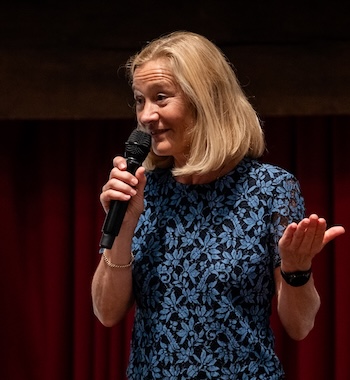
Micky Adriaansens, Chair of Nyenrode Business University, opened the event by reflecting on the 750-year history of the Nyenrode estate. At times, it seems that more change has taken place over the past few years than during all the centuries before. Leaders must learn to navigate this reality.
From globalization to a world of competing blocs
Rob de Wijk opened the program with an analysis of shifting global power dynamics. According to him, we are in the midst of a geopolitical transition in which economic, technological, and political developments are becoming increasingly interconnected.
The rise of China, growing competition among major powers, and the expanding role of technology are reshaping the environment in which organizations operate. De Wijk argued that leaders must prepare for a world where ongoing crises, geopolitical tensions, and uncertainty are becoming the norm rather than the exception.
At the same time, he sees the globalized world increasingly fragmenting into economic and political blocs. Trade, investment, and international cooperation are becoming more heavily influenced by geopolitical considerations. As a result, organizations need to rethink how they approach markets, partnerships, and international dependencies.
Resilience matters more than efficiency

One of the most visible consequences of this shift is the growing vulnerability of global supply chains and trade networks.
For years, organizations focused on optimizing efficiency. Today, however, they face new risks related to critical raw materials, technology, energy security, and international trade flows. According to De Wijk, the traditional 'just-in-time' approach has become a source of risk. The focus must shift from maximizing efficiency to building strategic resilience.
He also raised questions about Europe’s ambition for strategic autonomy. In his view, complete independence is unrealistic, given Europe’s reliance on critical resources that are not available within its borders. The challenge lies not in achieving full self-sufficiency but in reducing vulnerabilities and managing risks more effectively.
Adaptability as a competitive advantage
Despite the complexity of these developments, De Wijk ended on an optimistic note. Organizations that acknowledge geopolitical realities can strengthen their competitive position.
He pointed to the principle of adaptability: it is not the strongest that survives, but the one that adapts most effectively to changing circumstances. For leaders, this means that geopolitical due diligence is becoming an increasingly important part of strategic decision-making.
What do geopolitical developments mean for corporate governance?
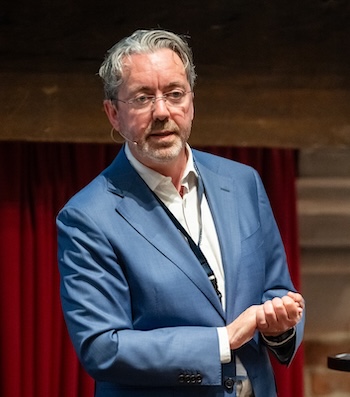
While De Wijk outlined the geopolitical context, Jeroen Veldman focused on its implications for governance.
According to Veldman, geopolitical issues have become a permanent fixture on boardroom agendas. The international environment in which organizations operate is becoming more complex, and differences between economic blocs are growing.
The era in which companies could operate largely within a single dominant international order is coming to an end. Organizations are increasingly confronted with diverging regulations, differing views on governance, and changing relationships between markets and governments.
This requires new governance considerations around issues such as the nationality of directors, companies, and shareholders, the structure of supply chains, and the way organizations define and implement sound corporate governance practices.
A Europe-first approach
Veldman therefore advocated a Europe-first strategy. Not as a form of protectionism, but as a framework for engaging with the world from a position of European strength and values.
Organizations, he argued, should adapt pragmatically to a changing world order while continuing to build on the principles that characterize the European tradition of corporate governance, including long-term thinking, responsible leadership, and societal accountability.
In a world where economic and geopolitical interests are increasingly intertwined, these values can help guide strategic decisions and strengthen European institutions.
Building scenarios, not making predictions
During the closing discussion, the question arose of how leaders should deal with growing uncertainty.
Veldman emphasized the importance of scenario planning. Organizations need to think about possible long-term developments. By developing multiple scenarios and preparing strategic options for each, they can create greater flexibility when circumstances change.
De Wijk warned against the illusion of prediction. In his view, geopolitical developments are similar to climate patterns: they indicate the direction in which the world is moving, but not the specific events that will occur in the short term.
His advice to leaders was clear: prepare for multiple outcomes. Develop the ability to be surprised by events without being caught off guard.
Geopolitics is leadership
The session made one thing clear: geopolitics is no longer a peripheral issue. Questions surrounding economic security, technology, international dependencies, and strategic autonomy are becoming increasingly central to corporate leadership and governance.
For executives and board members, this means that geopolitical developments should not only be monitored but actively incorporated into strategy, governance, and leadership.
That is precisely why the demand for knowledge, education programs, and research at the intersection of geopolitics and business continues to grow - a topic that is only expected to become more important in the years ahead.