Many organizations invest heavily in data and technology but struggle to generate meaningful business value from those investments. Initiatives are often driven by the urgency to “do something with AI,” without a clear understanding of where it can make a real difference within the organization.
The module Business Value of Data & Technology addresses exactly that challenge: how do you turn technology into a strategic asset rather than a cost center? According to lecturer Gerard Wijers and participant Marina de Olde, Head of Data & Insights at Geldmaat, that distinction is what ultimately determines success.
Better questions lead to better decisions
"The module helps you make much more deliberate strategic decisions. Just because something is possible doesn’t mean you should do it." - Marina de Olde
After more than twenty years in commercial, operational, and program management roles within the financial sector, De Olde saw data playing an increasingly important role in strategic decision-making. Her desire to move beyond implementation and execution grew stronger as she became involved in major ESG and risk transformation initiatives. “You notice that data and technology increasingly influence strategic decisions,” she explains. “But I wanted to better understand how to make that translation: where does data actually create value?”

What stayed with her most from the module was not a new set of technical skills, but a different way of thinking. “In many organizations, technology is the starting point,” she says. “A new development emerges, and the first question becomes: what can we do with it? In this module, you learn to reverse that logic. You start with the business and then ask: where can technology add value?”
This approach encourages participants to look beyond systems and data alone. It requires understanding the broader context in which technology is used: organizational culture, ways of working, and the readiness of teams to embrace change. “You learn to combine different perspectives,” De Olde explains. “As a result, you make much more deliberate decisions. Just because something is possible doesn’t mean you should do it.”
Why technology often fails to deliver value
That principle - just because you can, doesn’t mean you should - lies at the heart of the problem, according to Wijers. In his work as an advisor, he frequently sees organizations investing in technology without a clear strategic direction.

“Many companies still treat technology as a cost item or simply as something they need to have,” he says. “But if you don’t approach it strategically, initiatives remain fragmented. You end up with pilots that have little impact or projects that gradually disappear.”
The same is true for today’s wave of AI applications. Organizations feel pressure to keep pace with technological developments, but often lack a framework for making informed choices.
“If you’re not clear about where you want to create value, technology quickly becomes an experiment,” says Wijers. “Experimentation is fine, but it needs to lead somewhere.”
One size no longer fits all
One of the key insights participants gain is that not all technology serves the same purpose within an organization. Wijers refers to this as “multimodal thinking.”
“A common mistake is treating all technology as if it were the same,” he explains. “But it isn’t. Some systems are foundational; they simply need to be reliable. Other technologies are differentiators that directly impact your competitive position.”
The ability to distinguish between those categories is essential. It determines where organizations should focus on optimization and where they should invest in innovation.
“If you treat everything the same way, you miss opportunities,” says Wijers. “You underinvest where it matters most and overspend where the return is limited.”
The growing urgency of digitalization
These questions are becoming increasingly important because of the speed at which technology is evolving. What was once mainly an efficiency issue has now become a matter of strategy and positioning.
“In virtually every sector, organizations are becoming more digital,” says Wijers. “Sometimes driven by competition, sometimes by labor shortages. But the direction is always the same.”
The COVID-19 pandemic made that reality impossible to ignore. Organizations with strong digital capabilities adapted quickly, while others struggled to operate.
“You still see that difference today,” he continues. “If you fail to move with the times, you fall behind. And that’s not something you can easily recover from later.”
Learning by doing
A defining feature of the module is its strong connection between theory and practice. Participants do not merely study frameworks; they apply them directly to challenges within their own organizations.
De Olde offers a concrete example: “We worked on an AI readiness and maturity framework. It helps you assess not only the technology itself, but also how mature your organization is in different areas. That makes it much easier to determine where AI should, and should not, be applied.”
The result is more than insight alone. “It doesn’t stop with learning concepts,” she says. “You actively work with them, which means you continue to use them long after the module ends.”
Leadership makes the difference
Although the content is strongly focused on data and technology, leadership plays a larger role than it might initially appear. Ultimately, digital transformation is not just about systems or data. It is about the decisions people make.
“You can’t solve these kinds of challenges through technology alone,” says De Olde. “It also depends on how you bring people along, how you organize decision-making, and how you set priorities.”
Wijers sees this as a critical component of successful digitalization. “Strategic decisions about technology are made at the leadership level,” he explains. “That’s where you need to be able to have the conversation and explain why you choose to invest or not invest.”
Not just for IT professionals
The module is not exclusively aimed at IT professionals. In fact, it is particularly valuable for managers and decision-makers whose roles involve data, technology, or digital transformation.
“Whether you’re a manager or a board member, if you make decisions in which data and technology play a role, this is relevant,” says De Olde.
A technical background is not required. “It helps if you’ve been exposed to these topics before,” Wijers adds, “but curiosity and a willingness to understand them are much more important.”
The value of learning with peers
“Technology is not an expense. It is a strategic asset, provided you know how to use it.” - Gerard Wijers
Beyond the academic content, De Olde highlights the importance of the learning environment itself. “You’re surrounded by people from different organizations who are dealing with similar challenges,” she says. “That leads to incredibly rich discussions. You learn as much from your peers as you do from the curriculum.”
Those connections often continue after the module concludes. “You build a genuine network of people you can reach out to for advice, ideas, or shared experiences. That’s incredibly valuable.”
Ultimately, both De Olde and Wijers arrive at the same conclusion: technology does not create value on its own. Value emerges when organizations make conscious decisions about where and how technology contributes to business objectives.
“Digital transformation is not just about systems,” says De Olde. “It’s about choices, behavior, collaboration, and understanding where technology truly adds value.”
Wijers puts it even more directly: “Technology is not an expense. It is a strategic asset, provided you know how to use it.”
Get more value from data and technology
The module Business Value of Data & Technology helps professionals translate data, AI, and technology into tangible business value. You will learn how to make better strategic decisions and leverage technology as a driver of growth, innovation, and improved decision-making. The module is taught in English and is part of the Modular Executive MBA, but can also be taken as a standalone module.
Related programs
-
Change Management and Organizational Development
Start date: 5 April, 2027Language:- Dutch
Location:- Breukelen
This module is only given in Dutch. Please visit our Dutch site.
View program
-
Cooperation and Leadership
Start date: September 10, 2025Language:- Dutch
Location:- Breukelen
This module is only given in Dutch. Please visit our Dutch site.
View program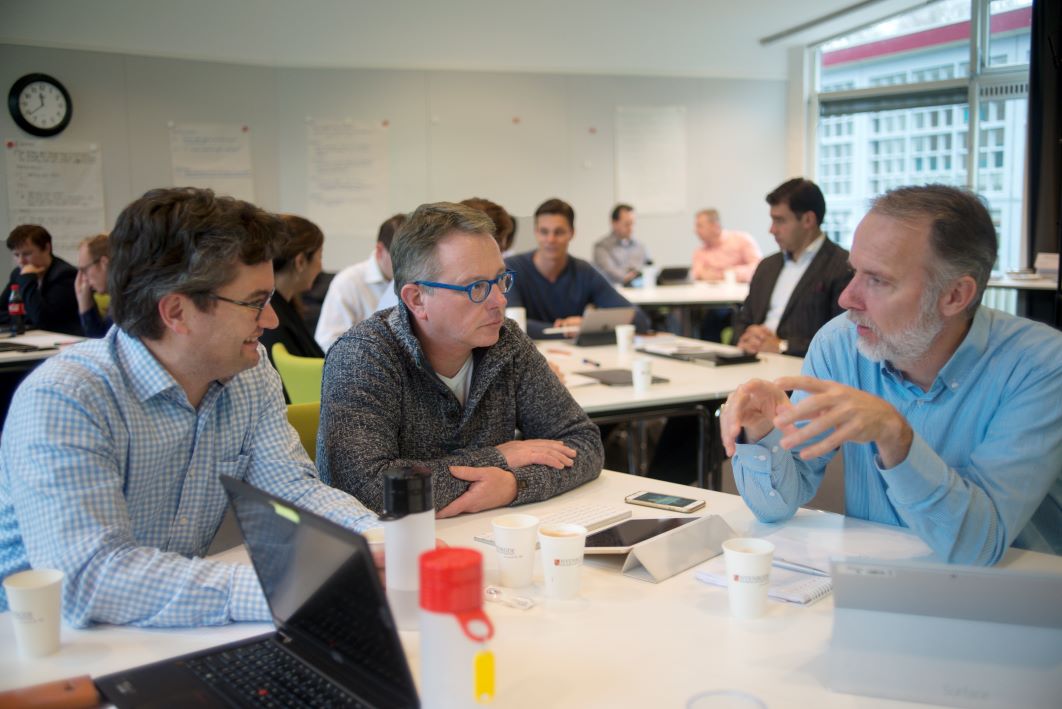
-
Modular Executive MBA in Business & IT
Start date: spring & autumnLanguage:- English
Location:- Breukelen
For professionals driving digital transformation. The Modular Executive MBA in Business & IT develops your expertise in AI, digital strategy, and IT leadership. A flexible, part-time MBA for experienced professionals.
View program
-
Modular Executive MBA in Business & Sustainable Transitions
Start date: spring & autumnLanguage:- Dutch
Location:- Breukelen
For professionals driving sustainable change. The Modular Executive MBA in Business & Sustainable Transitions deepens your expertise in strategy, transformation, and sustainable growth. A flexible, part-time MBA for experienced professionals.
View program
-
Modular Executive MBA in Public & Private
Start date: spring & autumnLanguage:- Dutch
Location:- Breukelen
For professionals operating at the intersection of the public and private sectors. The Modular Executive MBA in Public & Private deepens your expertise in strategy, governance, and collaboration. A flexible, part-time MBA for experienced professionals.
View program
-
Business Processes and Technology
Start date: March 11, 2027Language:- English
Location:- Breukelen
We will explore business processes and how technology shapes and improves them.
View program