
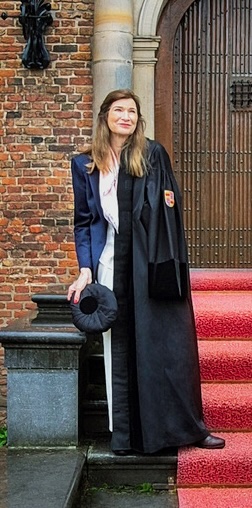
Working toward complex societal challenges with a future-oriented mindset, guided by participation as a leading principle; this has been one of the key drivers in the work of Professor of Strategy and Transformation Management Annemieke Roobeek. On March 27, she will deliver her valedictory lecture: the third part of a trilogy on democracy, this time focusing on the power of imagination.
“Democracy is the most fragile form of governance we have, and we must cherish it,” Roobeek states. At the same time, she observes that the underlying system - from economic innovation to healthcare and social welfare - has stalled. “We have become overly bureaucratic and distrustful of citizens. Instead of increasing control over subsidies, we should create more space for innovation by forward-thinking companies."
"Take the situation in Groningen, where people affected by earthquake damage had to navigate complex procedures for years. Or consider the childcare benefits scandal: many people are now afraid to apply for benefits, fearing they will end up on the ‘wrong list’ unjustly.”
A shift at the local level
According to Roobeek, decades of neoliberal policy have structurally undermined citizens’ trust in government. “On top of that, the influence of lobbying by established industries - such as oil and gas and the chemical sector - is significant. This comes at the expense of truly innovative high-tech companies that should form the new foundation of our economy."
"It forces us as a society to ask a fundamental question: from which vision, and in whose interest, are decisions actually being made? Why do the interests of our health, education, and future generations seem subordinate to those of a small group of dominant players?”
At the same time, Roobeek emphasizes that there is reason for optimism. “We are now seeing a shift taking place, particularly at the decentralized level.”
The power of the ‘happy many’
Throughout her career, Roobeek has been committed to what she calls the “happy many.” “The starting point should be that we contribute to the well-being of as many people as possible. That requires connection—bringing together people from diverse backgrounds and perspectives to collaborate.
By engaging in dialogue, we can work toward a vision of a city or country that is attractive to a broad majority. I call that a ‘desirable vision.’ And it’s not a problem if the process occasionally creates friction—tension can also lead to deeper understanding.”
When asked whether increasing polarization hinders open dialogue, Roobeek nuances this perspective. “In my view, polarization is amplified by politics in The Hague and by the media. In everyday life, people stand much more alongside each other than opposed to one another.”
From insight to impact
According to Roobeek, it is time for a new form of organization: political frameworks should be set collectively, while concrete implementation takes shape at the decentralized level. “Locally and regionally, we can achieve far more positive impact together than politicians in The Hague.”
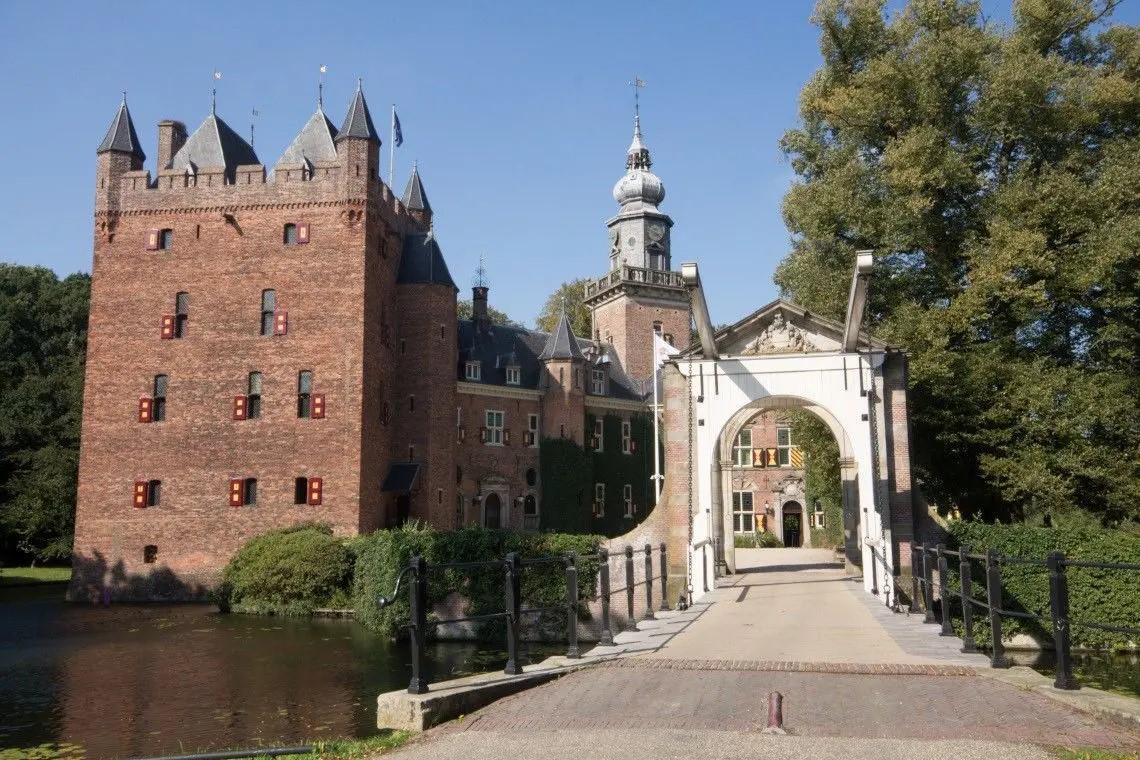
She also sees this development reflected in the business world. “More and more companies position themselves as a ‘force for good,’ which also helps attract talent. In addition, an increasing number of organizations, including Nyenrode, have obtained B Corp certification. This signals their intention to create positive impact for people and the environment, while still allowing for profit.”
The question then becomes how such a new system can take shape in practice. According to Roobeek, it starts with acknowledging and understanding complexity. “We must first make stalled systems transparent, and then translate them into understandable alternatives in accessible language. That’s how you create room for breakthroughs.”
Reason for optimism
In this process, Roobeek sees a key role for so-called “webbers,” a role she also identifies with herself. “Webbers are super-connectors who bring together people from different domains—government, business, and society. They are horizontal leaders who ensure that insights do not remain abstract, but are translated into concrete action, innovation, and tangible results.”
Since the beginning of her career, Roobeek has led many network projects in which she guided people to develop into webbers. “I do this by valorizing combinations of knowledge, daring to think differently, and creating space for new perspectives.” It is precisely in this last aspect that she finds reason for optimism. “People want to move forward, and that gives hope for the future.”